


⚠️ Security Notice for Recent Website Visitors (23–26 May 2026)

more info >>

How To Make Small Talk & How To Improve: 10 Tips For Introverts

Background waves
Small talk. Some people love it, some people barely notice it’s happening, others will do anything they possibly can to avoid it.


Whether that’s hiding in the toilet, mindlessly scrolling through your phone or hovering by the bar pretending to be otherwise engaged. If you’re in the latter category, read this blog for some quick tips to master the art of small talk.


1. Reframe

As with many situations that require putting yourself out there, like a presentation or a speech, small talk is often exacerbated by the negative thoughts that build up in our heads. This can make the situation bigger and scarier than it needs to be. If you hate small talk, you might recognise some of these thoughts:


“I must look so awkward right now.”

“I’m such an embarrassment.”

“Why can’t I think of anything to say?”

“I’m so bad at this.”


If these are familiar, try this simple reframing technique. If you notice a negative thought, try to swap it with a positive one:


“I’m an interesting person with plenty to contribute.”

“The anxiety is coming from my brain, not the situation. I look confident from the outside.”

“I’m more capable than I think.”

“I’m not the only person here who feels nervous. If I strike up a conversation with someone, they’ll feel grateful.”


Even if you don’t entirely believe these statements yet, the positive self talk will give you a boost and get you feeling more comfortable when it comes to making small talk. Scientific studies have shown that how we talk to ourselves has a huge impact on our confidence levels.


2. Go in with purpose

Small talk can often feel like useless chatter – do you really need to have yet another easily forgettable conversation about the weather, or what you do for work? Believe it or not, small talk is much more than this. It helps build the foundation for deeper connections and authentic conversations, which ultimately lead to relationships that might serve you for years to come. Once you start building rapport and trust with someone, you can start moving into more meaningful conversations. Think of the chit chat as a bowl of nuts that whets your appetite before diving into the main course! It’s really just a warmup that’s necessary before getting into proper conversation.

Try setting yourself a clear goal – maybe you commit to meeting three new people at a barbecue, or you exchange contact details with five other professionals at a networking event.


3. Get curious

“To be interesting, be interested.” – Dale Carnegie

Introverts tend to be curious people, keen to move past the shallow chat and delve into deeper topics that interest them. Don’t be afraid to show enthusiasm and channel your natural curiosity when it comes to small talk. If you show genuine interest in what they’re saying, you’ll invite further discussion and get off on the right foot for future conversations. You never know, you might just find something in common and bond over that similarity.


4. Ask questions

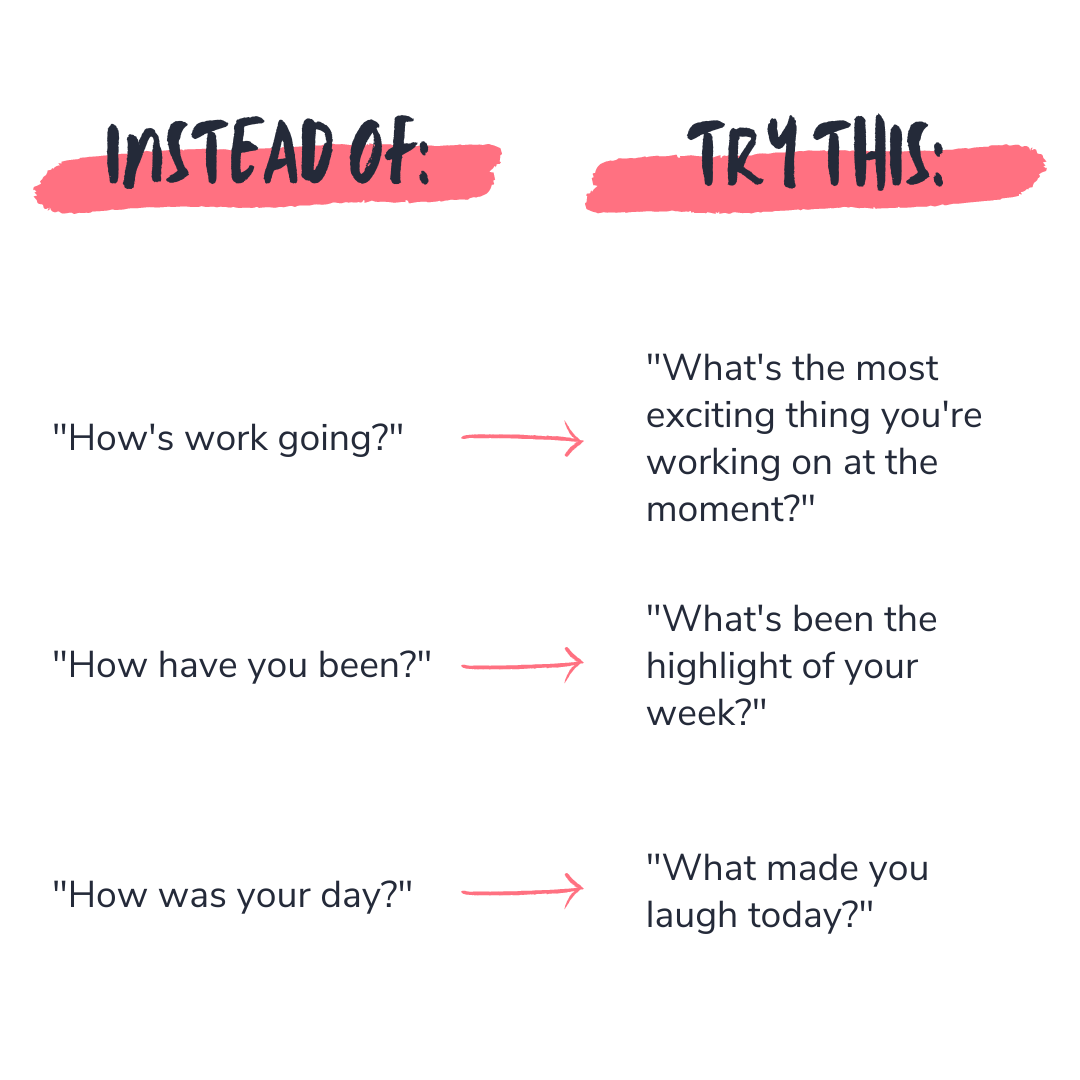
Introverts tend to hate the feeling of being in the spotlight, and would much rather direct the attention to someone else. A simple way to ensure this is to ask questions. Questions are powerful rapport builders because a genuine question is like a statement of interest, and that marks the beginning of a connection. Not to mention it takes the limelight off you for a short while! If you feel uncomfortable mid-conversation, ask more questions and subtly turn the attention away from yourself. A question conveys to the other party, ‘I want to know what you think’ or ‘I want to know more about you.’ Open questions can be more powerful than closed questions because you are inviting the other party to go further than a yes or no answer. Try using questions that start with ‘how’, ‘what’ or why’ – these tend to require more than one word answers. Here are a few small talk questions to get you started:
July social creative (2)-1


5. Add spice

Whilst it’s a good idea to ask questions, if you’re more comfortable moving the spotlight from you to them it’s also important to share a bit of yourself when the moment feels right. When you’re asked a question, try to avoid one-word answers – these are almost guaranteed to make the conversation fizzle out. Instead, embellish your responses with a bit of spice – this might be a snippet of a story, a personal opinion, a funny anecdote or an observation. Remember – it’s the detail that is unique to you that makes people interested. This is where people laugh, smile and feel connected.

For example, rather than responding to “how was your journey here?” with “good thanks”, try going for a more interesting and thoughtful response by including a snippet of detail – “it was lovely thanks. I decided to get off the tube a couple of stops early so I could walk along the riverfront, and I’m glad I did because there was a parade happening which was really exciting”.


6. Match their energy

If you are walking with a 90-year-old woman with a hip replacement, you would slow down… right? Small talk is much the same. If someone is speaking slowly and with low energy, then you will be hard pushed to build rapport if you’re rattling on at high speed. Equally, if they’re excitable and extroverted, use your body language to get on their level. You want to make an effort to meet them where they are in order to connect. You will find that by simply switching on your awareness of how the other person is speaking, you can assess what tone of voice, pace and volume suits the situation. As long as you are in the general ballpark, you will be en route to building rapport.


7. Notice other people

The real craft of making someone feel important is to pay them good-quality attention. People love to feel noticed. Numerous studies have shown that people are motivated and work harder when they feel attention and interest from others. You can ‘notice’ people in so many ways, from remembering important occasions, to referencing something they said or complimenting an outfit or hairstyle. If you can show someone that you are interested in them, you’ll go a long way towards making them interested in you.


8. Don’t forget to smile!

Use your smile to make a first impression on someone – you will be surprised by its power. But the smile has to be genuine to be really effective. Genuine smiles are good for making an instant positive impression. We are naturally more drawn to smiley people. Not only does a genuine smile have a positive effect on people receiving it, but as it is linked to the part of the brain that manages positive emotions, we also know that it can make the smiler feel good too!


9. Listen with your body

When someone actively listens, they are giving lots of nonverbal signals that they are interested in what the speaker is saying. Eye contact, open body language, small filler sounds – all of these make up active listening. If none of these are present, then it can get pretty uncomfortable for the speaker. However, if active listening does happen, the speaker will usually respond like an unfurling flower; they will give more information, become more colourful and expansive, and more receptive to the listener.


10. Rehearse conversation openers

Just like it’s important to practise your speech or presentation out loud, this can be done with small talk too. You might feel silly when practising alone at home, but this is a guaranteed way to build up the muscle memory and help the words flow when you get to the real thing. You can practise in less intense scenarios too – why not set yourself the challenge to make meaningful small talk every day? This could be with your colleagues, a shop assistant, the train conductor or a family member you haven’t spoken to for a while. It’s fine to have a few conversation openers up your sleeve – this will not only help you start great conversations, but also relieve some of the anxiety of walking into a new environment. Here are some good small talk topics to start building on:


  • Food
  • Travel
  • Weather
  • TV shows
  • Weekend plans
  • Exciting work projects
  • Music
  • Sport


Ultimately, be kind to yourself and remember there’s no pressure to suddenly be super entertaining and full of energy. Don’t be fooled into thinking you’re the only one in the room that’s nervous, or that everyone is noticing your awkwardness and nerves. There’s no one answer to mastering the art of small talk, but hopefully these tips help you get the most from it. Good luck!


For more tips like this, sign up to our monthly newsletter. If you’d like to get support on your communication style, take a look at our communication coaching options here. We also have a range of free resources to get you started on your communication transformation journey.

Photo of 2 people waving on an online call

Want to communicate with clarity and conviction?

Download our free eBook: ‘How to Speak More Clearly at Work’.

Download eBook
Topic:
Communication Coaches

Communication Coaches 

Job Description – May 2026

London Speech Workshop is a world-class communication coaching company, founded in 2008. We have coached thousands of professionals globally to become more confident, authentic, and impactful communicators.

Our work is deeply purpose-led. Through our proprietary Serlin Method®, we help bring more authenticity, respect, kindness, and empowerment into the workplace and everyday life.

We are growing our coaching team and are looking for exceptional individuals to join us as Communication Coaches, specialising primarily in Effective Communication, with opportunities to train in Accent Softening for selected coaches.


The Opportunity

We run monthly recruitment days and build a pipeline of outstanding coaching talent, with the next training cohort planned for September 2026.

This is a unique opportunity to join a highly regarded, values-driven company and be part of a warm, creative, and ambitious coaching community.


Who We’re Looking For

We are looking for coaches who combine technical skill with emotional intelligence and genuine warmth.

You will likely have:

  • 4+ years’ experience in communication coaching, teaching, or related fields
  • A background in voice, communication, performance, or coaching
  • Excellent listening skills and a strong ear for nuance
  • High emotional intelligence and the ability to build trust quickly
  • A natural ability to connect, empower, and bring out the best in others
  • A genuine passion for communication and personal development

Desirable (but not essential):

  • MA in Voice Studies, Communication, or similar
  • Understanding of phonetics
  • Experience in Accent Softening

What Makes This Work Special

  • A truly supportive coaching community
    Regular socials, meet-ups, and ongoing development
  • Monthly Coaches Meetings
    A space to share “green lights” and “opportunities,” receive support, and celebrate each other
  • Consistent, high-quality client work
    You provide availability; we fill your schedule
  • Flexible, hybrid working
    Work from home and/or our boutique London offices
  • Outstanding operational support
    Our back-office team handles logistics so you can focus on coaching
  • Training in the Serlin Method®
    A powerful, practical, and deeply human approach that transforms how people communicate
  • A values-led culture
    Warm, creative, dynamic, and deeply committed to meaningful impact

Training & Start Timeline

  • Recruitment: Ongoing, with monthly selection days
  • Training Cohort: July or September 2026
  • Training Commitment: ~20–30 hours over 4–6 weeks
  • Start Date: Post-training (Autumn 2026)

Requirements

  • Minimum 2+ years coaching, teaching, or facilitation experience
  • Background in communication, voice, performance, or related field
  • Availability for 16+ hours per week (including some evenings/weekends)
  • Availability to attend training in September
  • Native or bilingual English speaker
  • Based within commutable distance of London

Compensation

  • Highly competitive rates
  • Discussed during the interview process

Diversity & Inclusion

We are committed to building a diverse and inclusive team.
We welcome applications from people of all backgrounds, identities, and experiences.

If you require any adjustments during the process, please let us know.


How to Apply

Please send:

  • Your CV
  • A short email introducing yourself
  • A short video or voice note (max 2 minutes)

To: careers@londonspeechworkshop.com

Your video should include:

  1. Your full name
  2. Your relevant experience
  3. Why you’d like to work with London Speech Workshop
  4. Why you care about helping people become better communicators
  5. Your availability and current commitments

Final Note

We are always looking for exceptional people.
If you feel aligned with our values and excited by our work, we would love to hear from you.

Management Accountant / Finance Lead

Management Accountant / Finance Lead at London Speech Workshop

London (Hybrid) | Part-time (2.5 to 3  days/week) | £45k to 60K FTE depending on experience

About Us

London Speech Workshop is a values-led communication coaching company helping people speak with confidence, authenticity, and impact. Through our Serlin Method™, we blend psychology and performance to create powerful, human transformation for individuals and organisations alike.

We operate across B2B (corporate programmes) and B2C (individual coaching via online purchase), and are entering an exciting phase of growth across both.

We’re a warm, dynamic team with a simple ethos: do meaningful work, and do it well.

The Role

This is a broad, hands-on role owning the full financial function of the business — with scope to act as a strategic partner to the leadership team.

You’ll move between detail and big picture: ensuring everything runs smoothly day-to-day, while helping us understand performance, improve profitability, and make confident financial decisions.

Working Setup

  • 3–4 days per week (flexible)
  • Remote-first
  • One full day in the Farringdon office every fortnight (Tuesday or Thursday)

What You’ll Own

1. Financial Operations 

  • Daily bookkeeping in Xero across B2B and B2C
  • Payroll preparation and reconciliation
  • Credit control and client invoicing
  • Bank reconciliation and payment tracking
  • Managing accounts payable and receivable
  • Maintaining clean, accurate financial records with minimal oversight
  • Liaising with external accountants (year-end, VAT, tax)
  • Payroll preparation and reconciliation including pension submissions and auto enrolment 

2. Reporting, Compliance & Cashflow

  • Monthly management reporting (P&L, summaries, insights)
  • VAT returns and tax coordination
  • Monthly cashflow forecast
  • Clear visibility on cash position, risks, and liabilities
  • The production and maintenance of annual budgets, with regular forecasting and variance reporting

3. Commercial Insight & Strategy

  • Provide financial clarity to support decision-making
  • Translate numbers into clear, actionable insight
  • Help ensure revenue growth aligns with profitability

4. Business Modelling & Analysis

  • Analyse B2C performance (pricing, discounting, utilisation)
  • Model coach capacity, hiring decisions, and revenue potential
  • Support development of B2B commercial models (e.g. retainers, larger contracts)
  • Build simple financial models to guide strategic decisions

5. Cost & Efficiency

  • Review cost base and identify inefficiencies or savings
  • Recommend leaner ways of operating
  • Explore automation/AI opportunities where relevant

6. Incentives & Performance Metrics

  • Support design of:
    • Coach incentive structures
    • Bonus and profit-share models
  • Model key metrics such as:
    • Customer lifetime value (LTV)
    • Cost of sales
    • Utilisation and capacity

Who You Are

  • A qualified accountant ( ACA/ACCA/CIMA)
  • 3+ years in a bookkeeping / finance role
  • Strong Xero proficiency (non-negotiable)
  • Experience with payroll, VAT, and reconciliations
  • Comfortable owning the day-to-day finance function independently
  • Commercially minded — you go beyond reporting
  • Strong organisational and admin skills
  • Clear, warm communicator
  • Proactive problem-solver who anticipates needs
  • Experience supporting founders or small teams is a plus

Why Join Us

  • Flexible, part-time role with real autonomy
  • A values-led, human business doing meaningful work
  • A rare blend of execution and strategic input
  • Opportunity to shape financial clarity and growth

How to Apply


Marketing Director Role at London Speech Workshop 

Marketing Director, London Speech Workshop 

London (Hybrid) | £50–75k + bonus

About Us

London Speech Workshop is a values-led communication coaching company helping people speak with confidence, authenticity, and impact. Through our Serlin Method™, we blend psychology and performance to create powerful, human transformation, for individuals and organisations alike.

We work with SMEs, charities, and household names including Unilever, Chanel, John Lewis, and the Bank of England. We’re in an exciting growth phase across B2B, B2C, and digital, and marketing is central to this next chapter.

We have a lateral working structure, a warm and dynamic team, and a simple ethos: our people should feel valued and know they’re delivering real value in the world. We look for good eggs with talent and grit.

The Role

This is not a purely strategic role. You’ll be deep in the detail; building funnels, shaping messaging, testing ideas, and driving performance, while leading a Marketing Manager and managing freelancers, agencies, and partners.

One morning you’re sketching a landing page wireframe. That afternoon you’re coaching your manager or reviewing PPC performance. You’re as comfortable in the data as you are in a creative brief.

What You’ll Own

Growth & Funnel Performance

  • Own the full funnel: awareness → lead → nurture → conversion
  • Build and optimise landing pages, journeys, and conversion flows
  • Run continuous testing (CRO, A/B, messaging) to improve performance

Paid & Performance Marketing

  • Own strategy and results across PPC (Google, Meta, LinkedIn, YouTube)
  • Manage agencies and freelancers — setting direction and pushing for better ROI
  • Allocate budget based on data, not instinct

Campaigns, Content & Execution

  • Plan and deliver campaigns across email, organic, paid, and partnerships
  • Shape high-converting landing pages, lead magnets, and email sequences
  • Ensure all content is on-brand: intelligent, warm, human, and impactful

Data, Team & Systems

  • Be obsessed with metrics: conversion, CAC, LTV, engagement
  • Own HubSpot (or similar): automation, segmentation, reporting
  • Manage and develop a Marketing Manager; brief and oversee designers and developers

Who You Are

  • 6–10+ years in growth and performance marketing
  • Have owned PPC and know what “good” looks like
  • Have built funnels and campaigns yourself — not just directed them
  • Confident with HubSpot, Figma/Canva, and analytics platforms
  • Strong copy instincts and an eye for conversion
  • Commercially sharp, driven by results not vanity metrics
  • Genuinely curious about people, behaviour, and what makes communication work

Salary & Benefits

  • £50,000–£75,000 DOE + performance bonus
  • Hybrid (2 days/week in our London office)
  • Learning budget + access to our training
  • A fast-moving, ideas-friendly team that lives what it teaches

How to Apply

  • Send your CV, a short cover note, and a max 2-minute video or voice note to Emma at careers@londonspeechworkshop.com
  • In the video, tell us: what excites you about this role, a marketing project you’re proud of, and your salary expectations.